

Eduardo Gageiro
They described him as the ‘photographer of the people and of the revolution’. He defined himself as ‘a man of courage behind a camera’.
He has lived all his life in Sacavém, where, in the old Crockery Factory, he interacted with painters, sculptors and factory workers who decisively influenced his choice of photojournalism. Eduardo Gageiro started taking photographs at the age of 12, with a camera borrowed from his brother, which he never returned.
1.jpg
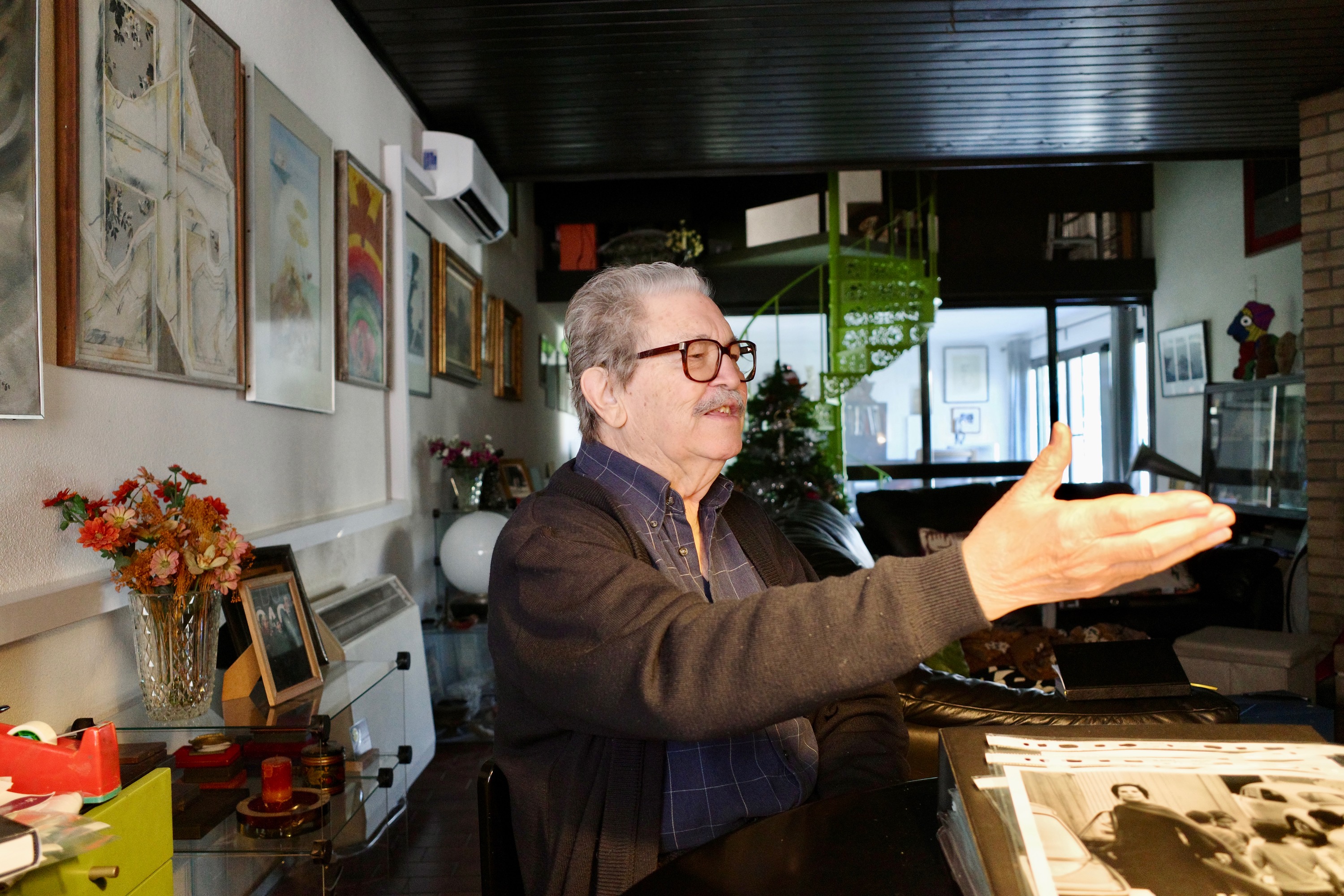
Photo provided by Manuel Falcão
Later, with the influence of Armando Mesquita, a ceramics master, he persuaded his father to buy him his first camera. In the early days, he took his black and white photographs, captured with natural light, a characteristic that set him apart, to art salons around the world, where he soon began to be honoured and win prizes that revealed the unique talent that would mark his career.
He began his professional career collaborating with two of the most graphically innovative newspapers of the late 1950s and early 1960s: Diário Ilustrado and Almanaque magazine. However, it was mainly in the pages of Século Ilustrado that the power of his photographic eye became truly evident.
2.jpg

National Archive of Torre do Tombo (1965/66) - Eduardo Gageiro at PIDE's premises
A photographer of people and life, it was with his famous Viúva da Nazaré, in 1963, that he won numerous international prizes and a unique recognition among his peers. In a time when Portugal's photography was still fragile, Gageiro stood out in a singular way, quickly establishing himself as one of the country's most important photojournalists.
In 1965, Gageiro was arrested by PIDE for sending photographs to the foreign press that exposed the living conditions of the Portuguese people and the injustices of Salazar's political regime.
The Revolution Through the Lens
At dawn on 25 April 1974, Gageiro walked through the streets of Lisbon to record the events and met Captain Salgueiro Maia in Rua do Arsenal, where forces from the Practical Cavalry School of Santarém were clashing with the troops of Cavalry Regiment 7, loyal to the dictatorship.
From that moment on, Gageiro followed Salgueiro Maia closely, becoming a privileged witness to the events of 25 April. The photograph that most marked his career shows the Captain of April in Terreiro do Paço, trying to contain his emotion by biting his lower lip.
Two other memorable photographic records of that day captured a soldier removing Salazar's portrait from the walls of the political police headquarters and a regime agent in his pants in Rua António Maria Cardoso; side by side, these photographs became powerful symbols of the fall of the dictatorship and the triumph of freedom.
3.jpg
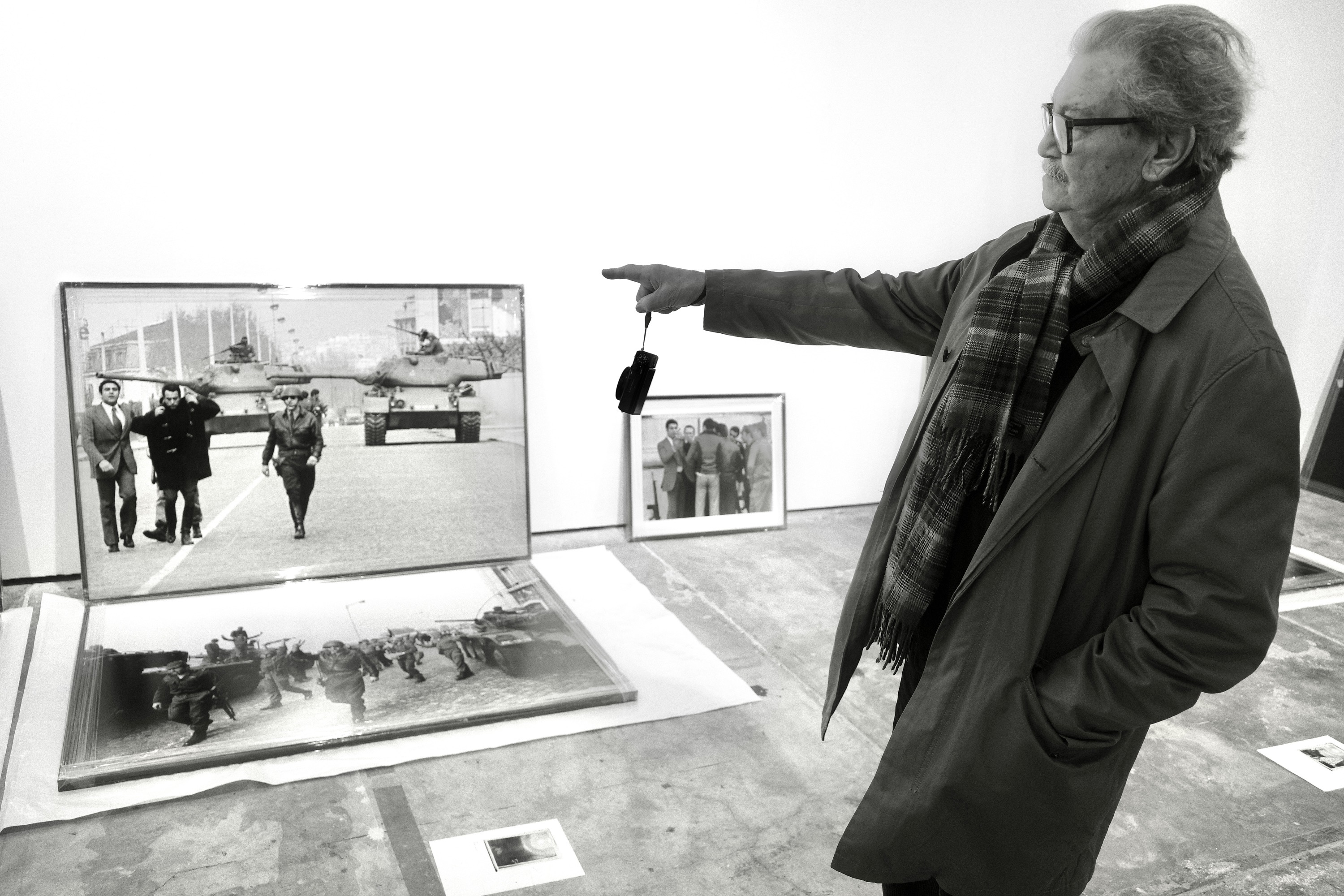
Photo provided by Manuel Falcão
‘The Tragedy of Impossibility’
For many people, this is the photograph that marked Portuguese and world journalism. Eduardo Gageiro, who happened to be following the Portuguese delegation on Canon business, found himself at the epicentre of one of the most shocking terrorist attacks in the history of the Olympic Games: the Munich Massacre. With ingenuity and courage, he infiltrated the Olympic village, joining a delegation from another country wearing a blue shirt identical to his own that day. And he climbed the stairs to the 16th floor, where the Portuguese delegation was staying.
4.jpg

Photo provided by Manuel Falcão
In the dim light of the balcony, he photographed the crucial moment when terrorists and hostages were about to board the bus, moments before the rescue at Fürstenfeldbruck Airport, which ended in tragedy.
The roll of film with the photograph was entrusted to a passenger, chosen randomly by the photojournalist, who gave it to a colleague from Século Ilustrado, who was waiting for him at Lisbon Airport. As soon as it arrived in the newsroom, the photograph was published on the cover of the next day's newspaper, immediately becoming a landmark in world photojournalism.
The Legacy of the Vision
The recognition he has achieved has allowed him to step away from the news for a while and devote himself to more in-depth work, such as portraits of key figures in Portuguese society. These portraits reveal lesser-known facets of those personalities: Jorge Sampaio as a conductor, Ramalho Eanes surrounded by his watches, or Miguel Torga... in slippers! The portraits also include Helena Vieira da Silva, Amália Rodrigues, José Cardoso Pires, Álvaro Cunhal, António Lobo Antunes and Maria Lamas, all captured with Gageiro's unique sensitivity, capable of revealing the most human and unexpected side of each person.
Eduardo Gageiro's work has travelled the world and has earned him more than 300 international awards, including 2nd prize at the World Press Photo in 1974 for his photograph of General António Spínola and, in 2005, the Special Jury Prize and Gold Medal at the 11th China International Art Photography Exhibition. In recognition of his contribution, in 2004 he was honoured with the Order of Infante D. Henrique by President Jorge Sampaio and is also a Knight of the Order of Leopold II of Belgium.
5.jpg

Photo provided by Manuel Falcão
Throughout his career, he has collaborated with renowned international newspapers and magazines such as the Herald Tribune, Stern, Paris-Match and Manchete, and has freelanced for prestigious institutions including Deutsche Grammophon, Yamaha and Cartier. He has published several books in partnership with writers and he is an honoured member of renowned international photographic associations, establishing himself as an essential reference in Portuguese photography.
In 2024, the year Portugal celebrated the 50th anniversary of the 25 April Revolution, the Cordoaria Nacional hosted a major retrospective dedicated to Eduardo Gageiro. Under the title Factum, the exhibition brought together around 170 photographs, tracing a vast portrait of his career and revealing the intensity of a gaze capable of crossing eras and retaining memories.
Eduardo Gageiro died on 4 June in Lisbon, aged 90. However, the echo of his vision remains: as Baptista-Bastos wrote, ‘Gageiro's photographs capture the tragedy of impossibility’. Images that don't expire at the moment they were taken, but which continue to tell us about the world, about life and about memory, immortals thanks to the sensitivity and strength of those who knew how to transform history into photography.