

USS Maine (1898)
On the night of February 15, 1898, a strong explosion sank the American warship “Maine”. The incident led the United States of America into war.
The war for independence began against Spanish colonial rule and North American newspapers reported the mistreatment that the Spanish authorities inflicted on the Cuban population and on American citizens residing on the island. The United States government responds to press pressure: on January 25, the American warship enters the port of Havana.
The Maine was one of the most modern ships in the American fleet and its arrival in Cuba was seen as a form of pressure on the Spanish. Three weeks after its arrival, the ship explodes and more than 250 sailors die.
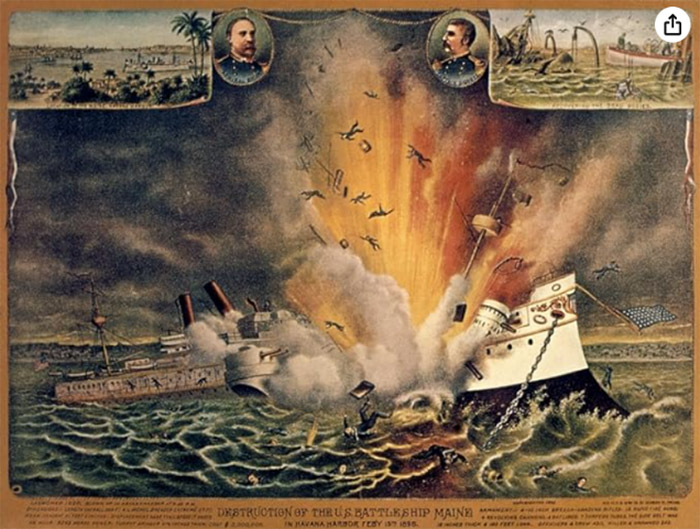
maine-2.jpg
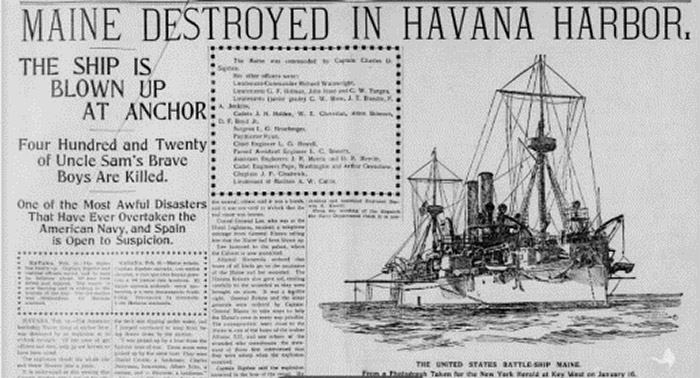
The San Francisco Call and Post
San Francisco, California • Wed, 16 Feb 1898
The case is explored and manipulated by the American press, especially the New York Journal and the New York World. The newspapers are merciless and accuse the Spanish of sabotage. Public opinion demands that the dead be avenged with the ‘cry’ created by the newspapers: “Remember the Maine”. Two months later, war is declared.
The Spanish-American War lasted less than 4 months. Before long, American troops invade Cuba and the war expands to the Pacific. The USA wins and the armistice is signed. Through the Treaty of Paris, signed in December of that same year, Spain ceded to the Americans what was left of its colonial empire: Puerto Rico, Cuba, Guam and the sovereignty of the Philippines. Spain ended up selling its remaining possessions in the Pacific to the Germans. It was the end of the Spanish colonial empire in America and Asia. It was the beginning of the global presence of the United States of America.
In 1976, Maine's remains were brought from Havana to the United States. The reason for the explosion was never clarified, but the most recent examinations point to an accident, caused by a fire in the coal or ammunition deposits. The Spanish had not sabotaged the ship. Fake news.
The phenomenon of media pressure exerted on American authorities was widely studied a posteriori. The type of journalism created by the bombastic headlines and inflammatory texts of that time was called yellow journalism (tabloid journalism). Pulitzer and Hearst are two of the media figures associated with the emergence of this journalistic model.
maine-3en.jpg
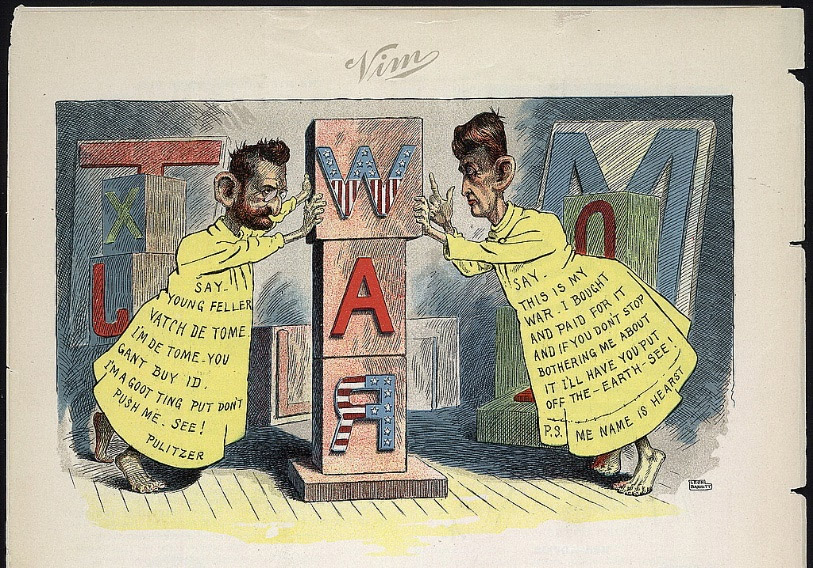
“The great typographic war of the yellow boys”, Vim, v. 1, n.º 2 (29 June 1898). Prints and Photographs Division.
In 1883, Pulitzer applied a series of new techniques with the aim of saving the newspaper The World. Since 1917, Pulitzer has been the name of the award that recognizes quality journalism and writing. Hearst follows in Pulitzer's footsteps and invites journalists from The World to work for his newspaper The New York Journal, including Outcault, the author of the emblematic yellow press comic strip: the Yellow Kid. Hearst was the inspiration for one of the most famous movie characters: Citizen Kane is William Randolph Hearst.